Overview
Eagle Rock Observatory comprises two fixed facilities: the domed observatory building and an observing pad with a permanent telescope pier. The observatory building is the newer and more capable facility, but the observing pad still has its uses.
This page provides brief descriptions of the Eagle Rock Observatory facilities and equipment. Some sections include a link to another page with more detailed information. The contents of this page are ...
The Observatory

The Observatory Building
The observatory building is a Technical Innovations Prodome Model PD-10, ten feet in diameter, installed on a 12x12 foot concrete pad. The walls are four feet high, and the peak of the dome is nine feet high.
The observatory is equipped with electric shutter and dome rotation motors. The dome motors can be controlled either manually or by an automated controller. Dome rotation can be synchronized to the telescope, and the entire system can be controlled remotely from the residence.
The building is located in an open space about 125 feet southwest of the residence. Utilities from the residence include two independent electric circuits, multiple ethernet and video cables, telephone, intercom, security system wiring, and a wiring conduit to an external weather station.
The observatory building was completed in September 2007, and first light was in October 2007.

The Telescope
The 16-inch Meade RCX400 was purchased in March 2007. It features Meade's Advanced Coma-Free optics and computerized go-to operation.
The specifications are
- Focal Length: 3251 mm
- Focal Ratio: f/8
- Aperture: 16 inches
- Theoretical Resolution: 0.29 arcseconds
Other notable features include:
- OTA fan
- Electric focus and collimation
- Built-in dew heater
- USB and reticle outlets on the visual back
The telescope is permanently installed on a LeSueur Manufacturing Astro Pier in altazimuth mode to optimize it for visual observing.

Support Equipment
Computer
The telescope and dome controller are interfaced to a Dell Optiplex 380 minitower computer with a 2.60 GHz Pentium dual-core CPU and 4 GB RAM, operating Windows 7 with Windows XP mode. The operating system has since been upgraded to Windows 10 Professional. A dual monitor graphics card allows the dedicated use of one monitor for a planetarium program and the second monitor for operation of the dome, weather station, and other observatory equipment. The observatory computer is interfaced to the household network and ultimately the Internet. A Saitek Eclipse PZ30AUR backlit keyboard simplifies using the computer in the darkened observatory. A removable red filter covers the right-hand monitor, and a privacy filter covers the left monitor during observing sessions to preserve night vision. The mouse and mouse pad are also dimly illuminated so it is easy to find the mouse in the dark.

Windows Remote Desktop allows remote operation of the observatory and telescope from any computer in the residence, including laptops with wireless internet connections. In practice, I use remote operation with considerable caution because of the danger of telescope slews against hard stops, jammed dome or shutter, and the like. However, remote operation is particularly convenient for routine computer upkeep and data transfers.
A UPS protects the computer from power surges and failures, and allows closing the shutter in the event of an extended power loss.
Furnishings

The concrete pad inside the observatory is covered with indoor/outdoor carpet, with a rubberized surface, over a closed-cell foam pad. The quality of the carpet and pad are important. The gap between dome and wall can't be completely sealed, and rain and snow will be blown into the building or carried in through the door. The pad is the best I could find. It provides welcome insulation for my feet on cold winter nights, and a soft landing in the event something like an eyepiece gets dropped.
Red and white rope lighting, controlled by independent dimmers, is installed under a circumferential wall flange to provide indirect lighting. Switched outlets around the walls and near the pier allow for future installation of work lights.
Two sets of wall-mounted custom shelving provide storage and work space. An additional pair of shelves accommodate the computer monitor, keyboard, and mouse.
A folding two-step stepladder, and a folding observing chair, provide access to, and seating at, the eyepiece when needed. In addition, I use a small rolling stool for seating at the computer. The stool fits neatly under the keyboard shelves when not in use.
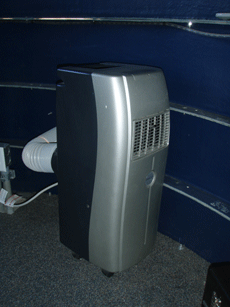
A portable air conditioner keeps the inside of the building below about 90F during the Summer, primarily to prevent damage to the telescope and electronics.
Finally, a portable vacuum cleaner and other cleaning supplies help me keep ahead of the Idaho dust that inevitably makes its way into the observatory.
The Observing Pad

The open-air observing pad is located about 50 feet southeast of the residence. It is a 10x10-foot concrete pad surrounding a LeSueur Manufacturing Astro Pier with a Polaris mount. The pier accomodates a removable Celestron C8 Deluxe eight-inch Schmidt-Cassegrain telescope, or any telescope with a compatible bolt circle on the base. The Polaris mount provides an adjustable equatorial mount for the telescope.
Utilities from the residence include electrical outlets, and multiple ethernet and video cables.
The observing pier allows the telescope to be brought out from an indoor storage room to the pier and set up for observing within five minutes. The telescope is in excellent polar alignment as soon as it is bolted to the wedge.
The observing pad was completed in September 2006.
Although the observatory and RCX400 telescope are far preferable to the observing pad for most purposes, the observing pad is still an excellent facility. In particular, it has the following uses:
- The shorter focal length (2000 mm) of the C8 telescope allows a larger useful field of view than the RCX400. Combined with the respectable aperture, this actually makes the C8 preferable for viewing some larger deep sky objects.
- The equatorial mount simplifies searching for deep sky objects using a star chart. This is useful for training, and for working toward certificates that forbid use of computerized goto telescopes.
- The open air environment is good for giving guided sky tours.
- It provides a useful overflow location when entertaining groups of more than a few people. The observatory can only accomodate two or three guests.
The disadvantages of the observing pad led to the decision to build an observatory:
- Although the telescope can be set up very quickly, it takes multiple trips to the storage room to set up and take down any support equipment such as the computer. The time, effort, and delay tend to inhibit starting an observing session.
- The total lack of shelter, combined with the seemingly perpetual wind, makes many good observing nights almost unendurable.
- In our largely treeless neighborhood, stray light from neighbors’ porch lights and passing automobile headlights are a frequent distraction.
- It is impractical to carry a larger telescope such as the RCX400 out to the observing pad, and unwise to leave such a telescope out in the open unattended.